The event is organized to introduce scientists to the cutting-edge achievements in the fields of energy systems and environmental engineering and to provide researchers – especially doctoral students – with the opportunity to publish the results of their work.
Each year, CONECT brings together around 200 scientists and researchers from more than 25 countries.
The main focus of this year’s conference will be on:
- Bioresources;
- Biotechnologies;
- Climate Communication;
- District Heating;
- Energy Efficiency;
- Environmental and Energy Policy Frameworks;
- Low Carbon Development and the Bioeconomy;
- Renewable Energy Technologies;
- Sustainability and Resilience.
Conference papers are published in an Open Access journal Environmental and Climate Technologies https://ect-journals.rtu.lv/ and are indexed in the Scopus and Web of Science databases. A selection of papers is recommended for submission as extended publications to other journals, which are also indexed in the Scopus database.
We invite you to take the opportunity to participate in the conference with your research by submitting:
- Abstracts by February 3rd;
- Papers by March 17th ;
- Posters by April 14th;
- Presentations by May 11th.
Early Bird registration will be available until March 31st; thereafter, registration will continue at the standard fee until May 1st . To apply, please visit: https://conect.rtu.lv/registration/
]]> Call for Applications: 11 PhD Positions at RTU Institute of Energy Systems and Environment (IESE) in Riga (Latvia)
The RTU Institute of Energy Systems and Environment (IESE) is a leading research institute specializing in innovative solutions for energy systems, environmental sustainability and climate change mitigation. With a strong track record of impactful research projects, international collaborations, and cutting-edge technological developments, IESE offers PhD candidates a stimulating academic environment equipped with advanced laboratories and expert supervision. Choosing IESE means joining a vibrant community dedicated to addressing some of the most pressing global challenges through interdisciplinary research and practical applications.
We are pleased to announce 11 fully funded* PhD positions in the following research areas, each offered as part of a 4 year full-time Doctoral Studies program with a start between 1 October 2025-1 January 2026:
- “Municipal-Scale Equilibrium between Carbon Drivers and Energy Use” (continuation of the successful project “Energy Equilibrium”)
- “Valorization and sustainability assessment of industrial conifer bark” (within “SuperBark” project)
- “Carbon farming certification system” (within “CarbFarmS” project)
- “Systems Dynamics modelling for climate neutrality” (read more about the project)
- “Behavioral interventions for transition to circular economy” (within “CIRCLEUP” project)
- “Resilience assessment in district heating systems” (within “DH INERTIA” project)
- “Textile fiber recycling from mixed streams” (within “PESCO-UP” project)
- “Multi-Energy Carrier Integration and Energy Hub concept” (within “OptiEnergyHub” project)
- “Resource efficiency strategies for circular bioeconomy” (read more about the project)
- “Policy planning for carbon sequestration in agroforestry” (within “CarbPol” project)
- “Hydrogen carriers for regional resilience of energy sector” (within “HI2 Valley” project)
*Study funding is available for the EU residents. Tuition fees apply for non-EU candidates.
 Requirements:
We are seeking motivated, research-driven candidates with a Master’s degree in Engineering or a related field (for the positions No.3 and No.10 – students with a Master’s degree in Policy and No. 5 – in Social or Behavioral Sciences are particularly welcome)
Strong/clear research interest relevant to the scope of the project/aligned with one or more of the listed projects
Full English proficiency
Experience/Hands-on experience relevant to the above-mentioned research areas/projects will be considered an advantage
Skills in experimental design, data analysis and scientific writing
Able to work independently under supervision
Deadline for application: 11 August 2025.
 Interested applicants are invited prior to send their CV and 1 page motivation letter via email to [email protected] with the subject reference: “PhD Position (please state the PhD title here)”.
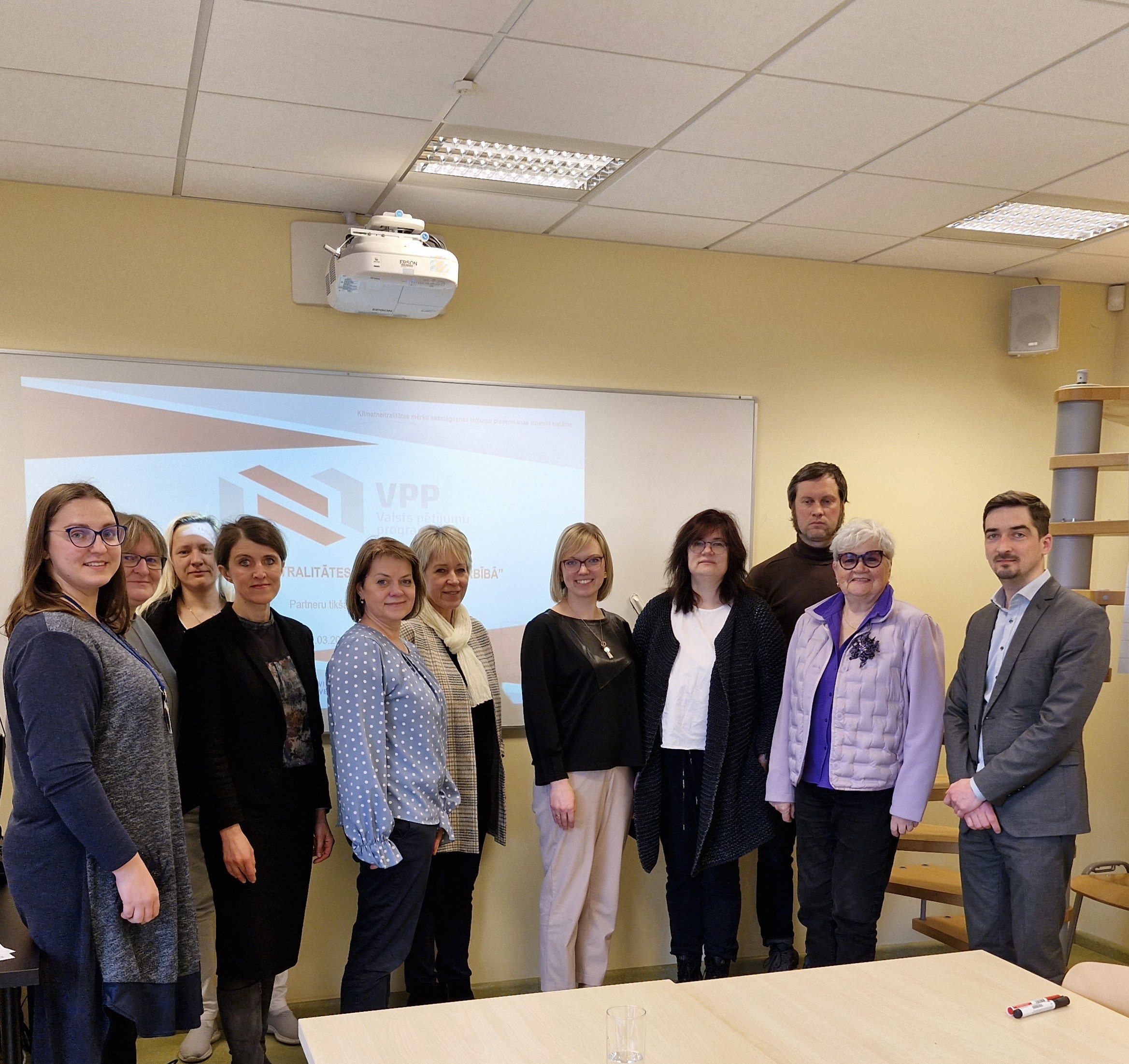
The project will be implemented from February 7, 2024, to February 6, 2026. The total budget of the project is 1,162,500.00 EUR.
Find more information here: https://videszinatne.rtu.lv/en/science/project-and-research/climate-neutrality-decision-models-in-action/
 ]]>
]]>Responsibilities and (foreseen) tasks
- Identification of waste heat flows in Latvia through literature and data analyses;
- developing the modelling tool for waste heat integration into district heating systems;
- Conducting the simulations for waste heat integration under various heating and cooling conditions;
- Preparing scientific publications and participating in international scientific conferences to present the obtained research results;
Applicants should fulfil the following requirements:
- a master’s degree in engineering (preferably in thermal engineering, power engineering or environmental engineering)
- a clear interest in the topic of the position
- excellent command of English
- strong and demonstrable writing and analytical skills
- capacity to work both as an independent researcher and as part of a team
We offer:
- 4-year PhD position in the highly motivated and active research team of RTU IESE, participating in international and national research projects on district heating, waste heat and energy efficiency.
- Opportunities for conference visits, research stays and networking with globally leading universities and research centres in the fields of energy and thermal engineering;
- Opportunity to apply for research grants and prepare scientific project proposals with a potential position as a researcher in our institute
Terms for application:
To apply for the doctoral study topic offer, send your CV and preliminary research plan to e-mail: [email protected] by August 20.
All requirements for doctoral studies at Riga Technical University are summarized here: https://www.rtu.lv/lv/studijas/doktora-limena-studijas/uznemsana-doktora
Additional information
For further information, please get in touch with asoc. Prof. Ieva Pakere [email protected] and see the institute webpage: www.videszinatne.rtu.lv
OTHER RELEVANT INFORMATION
We also offer applications for other topics related to energy efficiency, production and use of renewable energy resources, fuel combustion technologies, climate technology solutions, eco-design and life cycle analysis, energy planning, bioeconomy and many other topics. We invite you to contact us by writing to the e-mail [email protected] and/or calling the phone no. +371 67 089 923.
]]>Nowadays, consumers are more aware of products’ sustainability and circular aspects. However, on the other hand, implementing a substantial environmental strategy that addresses all phases of the product lifecycle is a complex and demanding challenge that several companies still need to overcome convincingly.
In this podcast, entitled “Life Cycle Assessment and Ecolabelling towards Circular Economy”, the speakers would like to clarify the use LCA as a quantitative tool to evaluate product’s environmental performances and its role in promoting Circular Economy solutions, Ecodesign and product’s ecolabelling.
Participants:
Francesco Romagnoli, Dr.sc.ing., professor, RTU VASSI;
Maksims Feofilovs, Dr.sc.ing., assist. prof., RTU VASSI;
Riccardo Paoli, M.sc., researcher, RTU VASSI.
You can listen to it here: https://anchor.fm/ilgtspejigas-pasaules/episodes/23-Life-Cycle-Assessment-and-Ecolabelling-towards-Circular-Economy-e1i4fti/a-a7sfrkp
You can watch it here: https://youtu.be/mDv27-lIP-c
]]>
The Institute of Energy Systems and Environment of the Riga Technical University in cooperation with the Nordic Council of Ministers’ Office in Latvia offering a series of podcasts “Sustainable Worlds”. The newest podcast entitled “Understanding complex dynamic systems in the world” is available for listeners.
The podcast episode will focus on how we understanding complex dynamic systems in the world. Professor Pål Davidsen from Bergen University in Norway and professor Andra Blumberga from Riga Technical University in Latvia will reflect on topic about dynamic systems. Discussion is moderated by Dr. Kārlis Valters form the Riga Technical University.
Most systems in nature, as well as in societies, are dynamic, i.e., they change over time. We, human beings, have a limited capacity to understand and imagine the complexity of such systems or the interactions that take place. To study these systems, scientists try to represent the reality in computer models. In doing so, they identify the mechanisms and interactions in the real-world systems and build structures of the systems. It is a problem-oriented approach, scientists try to find the underlying cause of the problem and what changes in the system to make to solve it.
What is the dynamic in ecology, for example, in the system deer-plants-predators? How a country can overcome an “addiction” to imported fossil fuels? How saving money on ventilation in schools affects the learning of children and ultimately the GDP of the country? How to solve the conflict between wildlife and people in Africa? System dynamics can provide answers to these and many other questions
The podcasts “Sustainable Worlds” can be found on
]]>
The Nordic Council of Ministers’ Office in Latvia in cooperation with the Institute of Energy Systems and Environment of the Riga Technical University offering a series of podcasts “Sustainable Worlds”. The newest podcast entitled “Historic buildings- heritage and beauty, coziness and warmth!” is available for listeners.
The newest podcast episode will focus on the energy efficiency in historic buildings. Dr. Ernst Jan de Place Hansen from Aalborg University in Denmark and professor Andra Blumberga from Riga Technical University in Latvia will reflect on topic about energy efficiency in historical buildings. Discussion is moderated by Dr. Kārlis Valters form the Riga Technical University.
Europe’s building stock is both unique and heterogeneous in its expression of the cultural diversity and history of our continent. About 30% of the buildings in Europe are built before the year 1945. Historic buildings, with unique and beautiful facades, cannot be insulated from outside. When they are insulated from the inside, problems arise with, e.g., condensation of humidity. What really happens in a wall insulated from the inside? How to insulate it in the best possible way? Can this be tested in laboratory?
The podcasts “Sustainable Worlds” can be found on
]]>
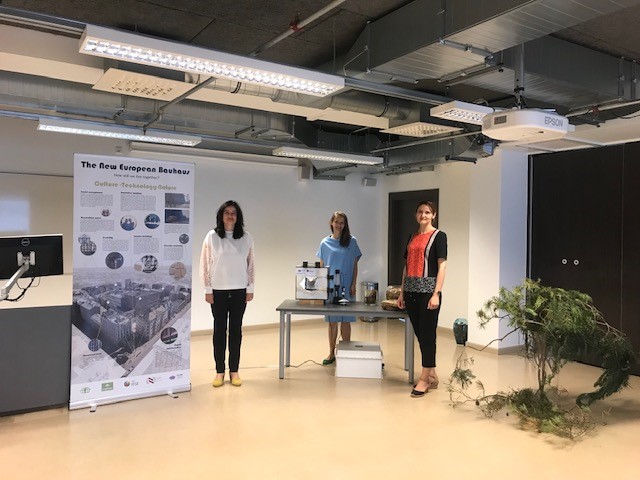
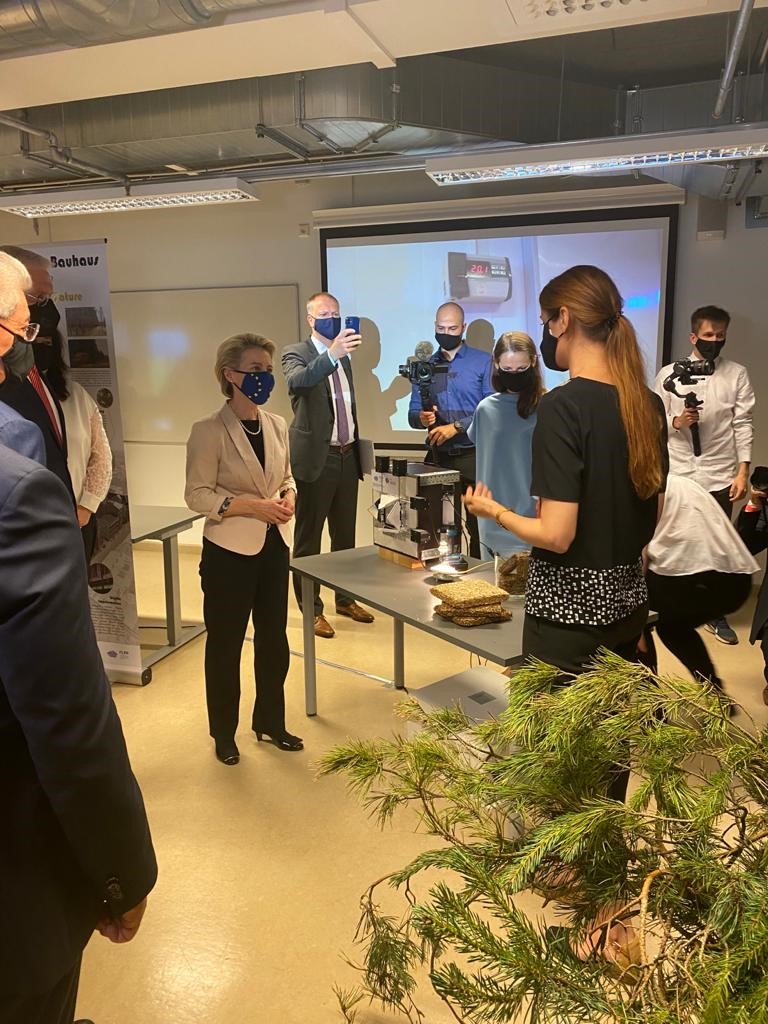
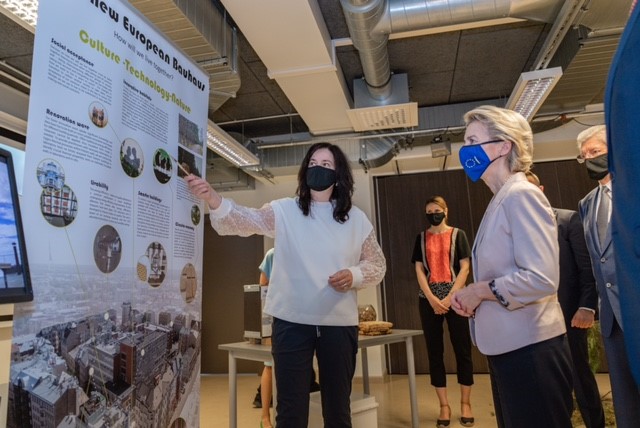
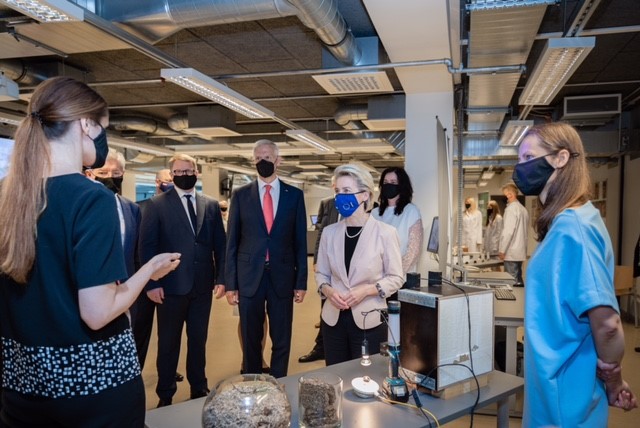
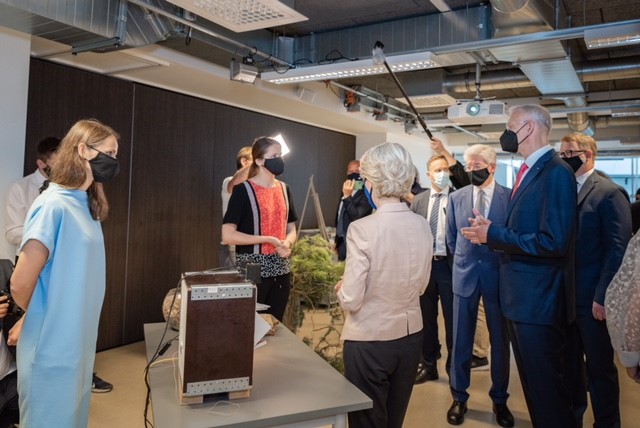
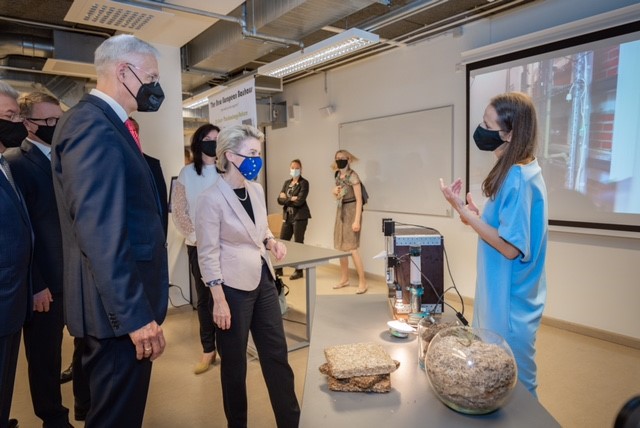
During the President of the European Commission (EC) Ursula von den Leyen’s visit to RTU, professor Andra Blumberga highlighted the social acceptance challenges in the energy transition to achieve The Green deal goals. Project “Bridging the Carbon Neutrality Gap in Energy Communities: Social Sciences and Humanities Meet Energy Studies (BRIDGE)” (Nr. lzp-2020/1-0256) will study behaviour patterns in the decision-making process on issues related to energy efficiency and energy community. Multi-player games will be created in the project allowing to reveal attitudes to crucial aspects in the energy transition.
In addition, EC president and Latvia’s prime minister Krišjānis Kariņš was acquainted with the natural thermal insulation material by showing how our communities can reduce the negative impact on the environment by making our living spaces energy efficient. Energy efficiency can be achieved by thermally insulating our living spaces. As at this point fossil or mineral solutions are not an sustainable option anymore, hence we in IESE are working on bio-based thermal insulation material. In line with the EU Green deal local bioresource must be used to produce higher added value materials. Natural thermal insulation material is made from forest logging residues and bio-based binder, as a result is has lower life cycle impact and is easily recyclable at the end of its life. In addition, it has better hygrothermal properties compared to conventional thermal insulation materials. We are looking forward to natural thermal insulation material to strengthen the EU bioeconomy.
For faster decarbonisation of building stock, we need conceptually new ideas on how we perceive building thermal envelope – what if it could become an active part of building energy balance? Senior researcher Ruta Vanaga presented dynamic solar facade system developed in Fundamental and applied research project “Smart building envelope with solar Energy storage (EVEREST)” funded by the Latvian Science Council (Nr. lzp-2019/1-0363). Innovative concepts can be borrowed from nature – the idea of this particular solar facade is borrowed from marine mammals that use oily layer of blubber for energy storage and insulation, so that the inner core of the body would keep constant temperature. In dwellings we need the same. A facade module acts as an energy converter – it harvests solar energy available on site, stores it in a phase change material that has significantly higher heat capacity compared to other building materials and releases to indoor space when needed. Active components adjusting to changes in intensity of solar radiation ensures faster harvesting of solar energy and prevents from heat losses, when solar radiation is not available. Thus, biomimetic ideas can help to create smarter buildings.
The Nordic Council of Ministers’ Office in Latvia in cooperation with the Institute of Energy Systems and Environment of the Riga Technical University offering a series of podcasts “Sustainable Worlds”. The newest podcast entitled “Clean energy- the only way!” is available for listeners.
The newest podcast episode is focused on the challenges and opportunities sustainable energy will feature. Professor Peter Lund from Aalto University in Finland and professor Gatis Bažbauers from Riga Technical University in Latvia will reflect on topic about sustainable energy. Discussion is moderated by Dr. Kārlis Valters form the Riga Technical University.
Currently, most of the energy in the world is produced from fossil fuels. Carbon dioxide emissions are causing climate change, which may lead to natural disasters, large numbers of climate refugees, climate wars and other catastrophic consequences. How will future generations look at the period in the history of the civilization, when energy was obtained by burning fossil fuels? What must be done? What can be done?
What are sustainable energy systems? How can societies transfer to low- to zero-carbon economy? Is it going to be “a revolution” or “an evolution”? What role will big data and artificial intelligence play? What are the current and future energy questions and solutions? What are the most promising technologies? What is the future of wind and solar energy? How can nanotechnologies be applied in the energy sector? What is a “prosumer” of energy? How will households look in 2030 regarding energy consumption (and production)? How will cities produce and consume energy in the future? What is the future of electric cars?
Some of the brightest minds are engaged in seeking answers to these and other questions and searching for sustainable solutions to our growing energy needs. However, more talent is needed. “We need more scientists than we currently have,” says Gatis Bažbauers. What does it take to be a scientist? What can a career in science offer?
The podcasts “Sustainable Worlds” can be found on
]]>