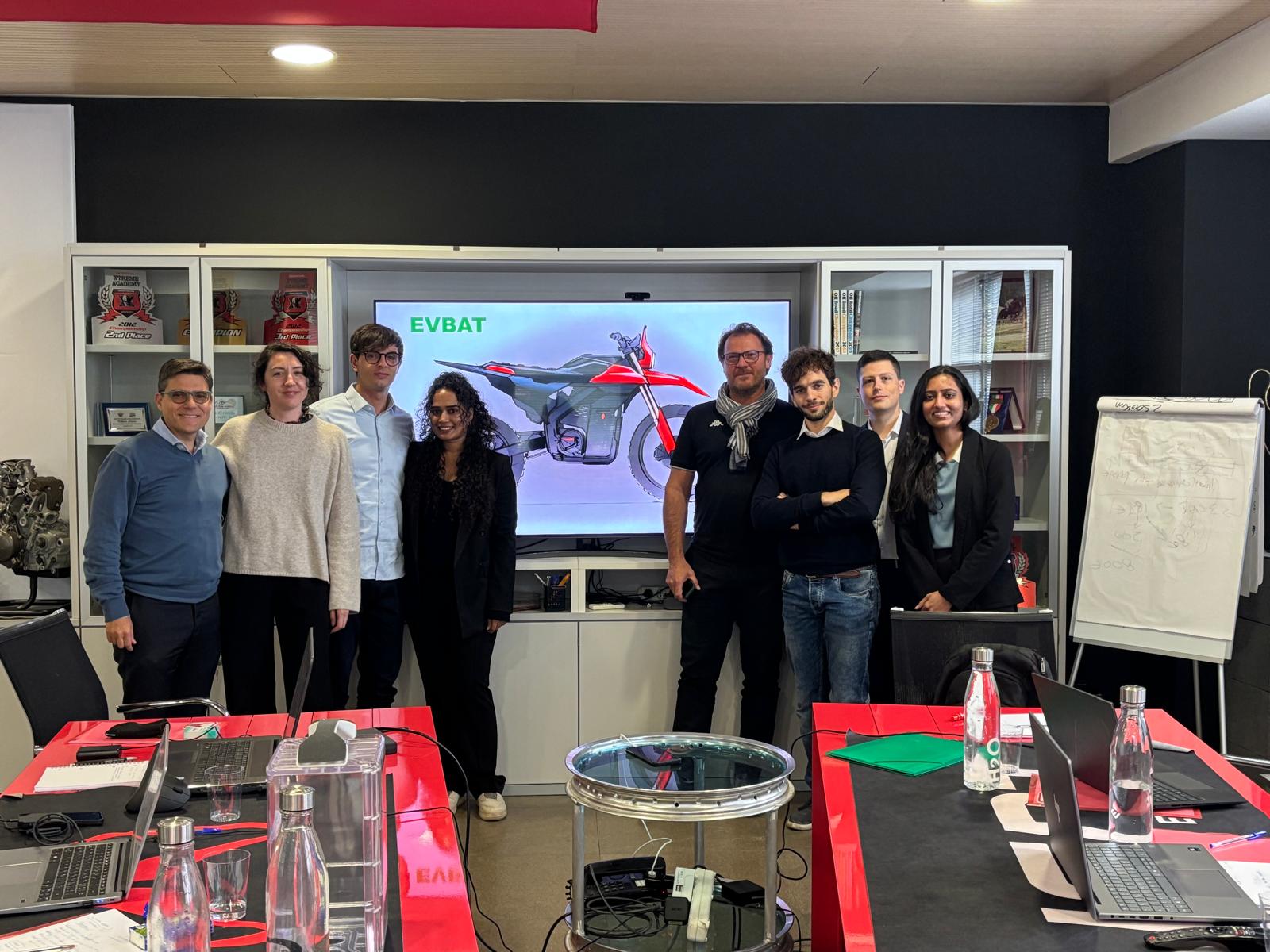
About the EVBAT Project
The EVBAT project addresses the growing needs of the battery sector by adopting a sustainable by design approach to next generation battery development. With a focus on swappable batteries for electric mobility, starting with E-scooters, EVBAT will deliver:
- Up to 30% CO₂ savings across the battery value chain
- Reduced charging times, addressing one of the most crucial challenges in the sector
- A circular and user-friendly solution for the future of urban mobility
Meet the EVBAT Consortium
The project brings together a diverse and interdisciplinary team of innovators from academia, research, and industry:
- HYBA (Italy) – Lead partner and producer of the innovative swappable battery system
- VENT MOTO (Italy) – Vehicle prototype developer
- LEVOX (Spain) – battery swapping station prototype developer for the pilot
- SE&C IKE (Greece) – Project management and dissemination
- RĪGAS TEHNISKĀ UNIVERSITĀTE (Latvia) – Life Cycle Sustainability Assessment and Critical Raw Material Evaluation
Funding & Support
This project is proudly funded by EIT RawMaterials and the Horizon Europe programme, driving innovation in sustainable mobility across Europe.
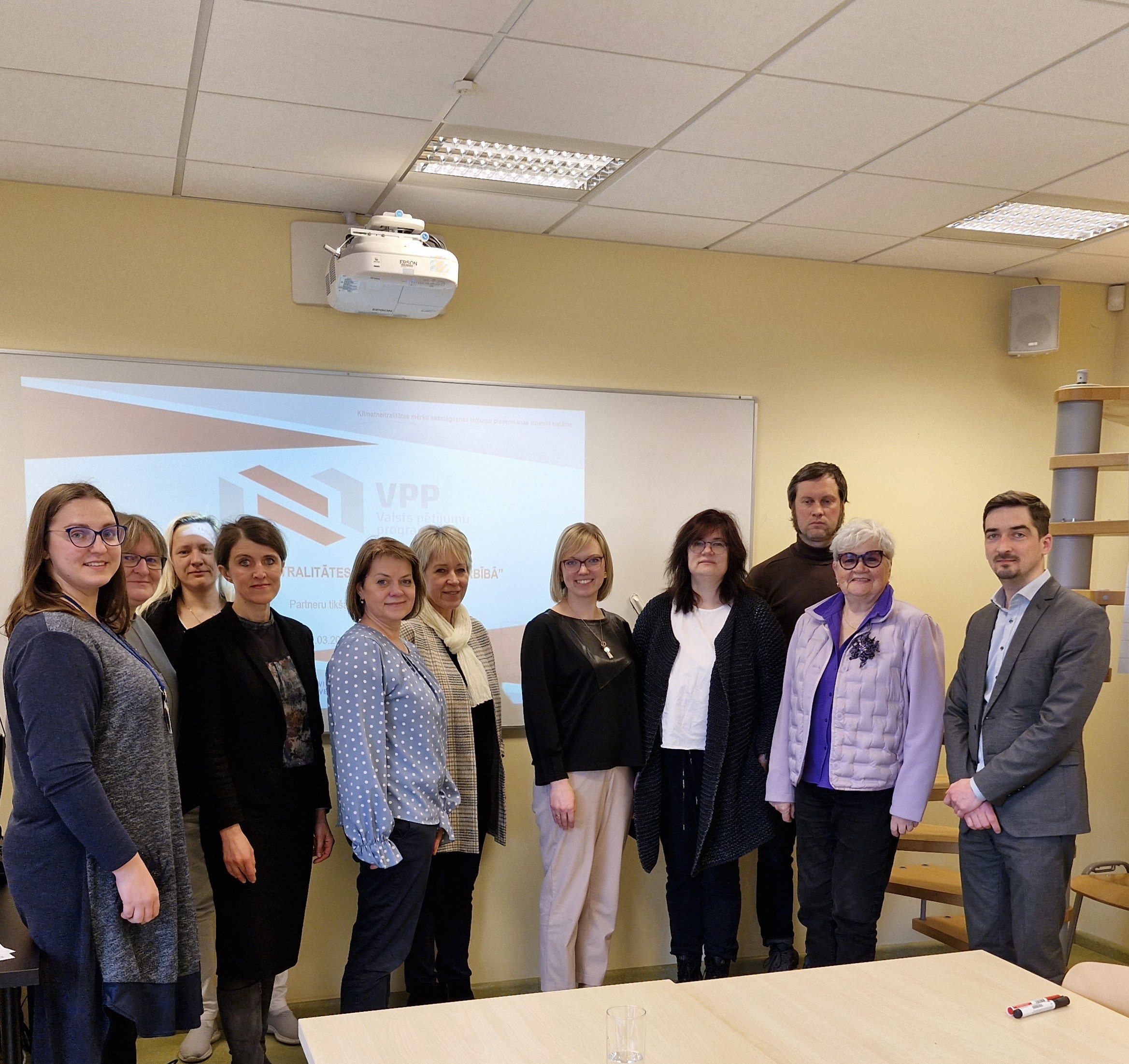
How to approach climate neutrality step by step and smartly integrate renewable resources? In the seminar, we will look for answers by delving into the synergies of wind and hydrogen, as well as getting to know best practice examples from the Baltic Sea region and discussing the latest policy trends.
We will offer an insight into innovative technologies, current events in the field of emissions and emissions trading, as well as the “hottest” topics that are currently important for municipalities and ministries.
Additionally, there will be an opportunity to get acquainted with the renewable energy transition roadmap and participate in a practical workshop, where we will try out innovative planning platforms for developing local energy strategies.
Participation in the seminar is free of charge, but the number of places is limited! Please register for the event by October 2 here: https://forms.office.com/e/svesRsY832
The seminar language is English, the workshop is in Latvian.
| Time | CONTENT |
| 10:00 – 10:30 | Registration |
| 10:30 – 10:40 | Seminar opening |
| 10:40 – 11:10 | Wind and Hydrogen Synergy: Pathways to a Sustainable Future, prof. Dagnija Blumberga, Riga Technical University |
| 11:10 – 11:30 | Liepāja Municipality’s Development Path towards 100 Climate-Neutral and Smart Cities by 2030, Karlis Beihmanis, Liepaja Municipality |
| 11:30 – 11:50 | The Tomelilla Example: A Municipal Perspective on RES Deployment and Tool Application, Ellen Boije af Gennäs Erre, Tomelilla minicipality |
| 11:50 – 12:10 | The Development Journey of Kuldīga Municipality, Agate Zirne, Kuldiga municipality |
| Break | |
| 13:00 – 13:30 | Emission trading system for buildings, road transport, and small industry (ETS2): How will we manage it together? Lelde Vistarte, Ministry of Climate and Energy |
| 13:30 – 13:50 | Roadmap for renewable energy transition in BSR municipalities, Per-Johan Wik, Sustainable Business Hub |
| Workshop for municipalities* | |
| 14:00 – 15:00 | Hands-on Workshop: Exploring the EnergyEquilibrium and CommitClimate Platforms, Alīna Safronova, Zane Pīpkalēja and Dace Lauka |
*in Latvian language
Seminar is organized within project Energy Equilibrium and CommitClimate, financed by Interreg Baltic Sea Region program.

The project will be implemented from February 7, 2024, to February 6, 2026. The total budget of the project is 1,162,500.00 EUR.
Find more information here: https://videszinatne.rtu.lv/en/science/project-and-research/climate-neutrality-decision-models-in-action/
The webinar will be held on January 23 from 10.30-12.30 (EET) on the MS Teams platform.
The webinar will be in English.
Registration for the seminar is open until January 22. The registration form is available below. After registration, a link to the MS Teams platform will be sent to the e-mail address specified in the form a day before the seminar.
The webinar is implemented in the framework of the Nordic Energy Research project WasteHeatSES.
]]>Place: RTU Scientific Library, Paula Valdena street 5, 2nd floor, Conference room 2.12A
TREASoURcE is part of the EU’s Circular Cities and Regions Initiative (CCRI) that seeks to support the implementation of circular economy solutions across Europe’s cities and regions. TREASoURcE project aims to initiate systemic change by developing technologies and systemic circular economy (CE) solutions in cities and regions for currently underutilized or unused plastic waste, end-of-life electric vehicle batteries and bio-based side and waste streams. Implementing these solutions together with companies, societies (including citizens, consumers, communities, and regional actors) and experts in the field is expected to significantly increase product and material circulation in the Nordic and Baltic Sea Regions.
WHO
We welcome local stakeholders from Latvia, like municipality and regional representatives, industry dealing or interested in these streams, as well as supportive stakeholders like policymakers and funding parties to take part in the interactive open discussion on identifying local needs, challenges, and motives to take up developed open access systemic circular economy solutions. In addition, all those who want to share their ideas on ways of developing the circular economy and modern thinking about recycling waste in an environmentally friendly way are welcome.
Attention: The number of participants is limited. The event takes place in English.
Please register by 18.05. via this link: https://forms.gle/mCgBGiqCcK9U1HfN8
WHY
Workshop aims at gathering insights on what kind of factors would have to be taken into consideration locally when circular solutions would be implemented in Latvia and specially in Riga area as well as identify your interests, needs and possible challenges regarding plastic waste recycling, utilization of bio-based side and waste streams for biogas and composting, as well as repurposing electric vehicle batteries as stationary energy storage systems.
We’ll be hosting three parallel sessions for each of the value chains to discuss the developed circular solutions in more detail and identifying potential for further uptake and replication. You can choose the topic that interests you the most.
ADDITIONAL MATERIAL
Before the workshop you can watch three presentations about the challenges of the plastic, bio-based waste, and battery value chains identified in Nordic countries.
- Plastic waste recycling – Mikko Myrä
- Bio-based side and waste streams for biogas and circular nutrients – Tran Ngo
- Repurposing electric vehicle batteries for energy storage applications – Nina McDougall
Link to the recording: https://treasource.eu/the-first-treasource-results-discussed-in-a-webinar/
- 13:00 Introduction (Pekka Niskasaari, project coordinator, Forum Virium Helsinki)
- Purpose of the workshop
- TREASoURcE in a nutshell
- Practicalities of the workshop
- 13:30 State-of-the-art of circular economy in Latvia (SPEAKER – Julia Gušča)
- 14:00
- Introduction to demonstrations
- Discussion on possibility and mapping activity on demonstrations and replication – potential, interest, needs, challenges
- Parallel workshop sessions: Plastics
- Plastics
- Batteries
- Bio-based side & waste streams
- 15:15 Presentation of results & group discussion
- 15:50 QA and wrap up
- 16:00 Event concludes
For further enquiries and information:
Oskars Švedovs [email protected]
Project is coordinated by VTT Technical Research Centre of Finland. Project Website: TREASoURcE – Territorial and regional demonstrations of circular systemic solutions
]]> ]]>
]]>Processing of resources and production of innovative products is essential to get and use knowledge in cleaner production, environmental technologies, energy efficiency, waste management, and other aspects, using resources effectively and reducing a negative impact on the environment. Implementation of bioeconomy is a key to self-sufficient and sustainable cities and regions. Bioeconomy is an essential part of the circular economy.
Bioeconomy defines the aspects of bioresource use and technological problems connected with the bioresource extraction and processing technologies and new product uses and eco-design. Participants will get to know raw bioresources, processing industries, technologies, innovations, and product eco-design within the summer school. The summer school participants will learn bioeconomy from A to Z by practical examples of specific local resources.
Other topicality of summer school will be connected with the introduction of research methodology in bioeconomy: data collection, processing and analysis of results using different computer models (multi-criteria analysis, different models of regression analysis, geographical information systems and system dynamics modelling).
The goal of the summer school is to teach participants how to mitigate climate change by implementing bioeconomy, sustainable use of bioresources and creating innovations and spreading the knowledge in their countries. The summer school participants will gain knowledge, contacts for further cooperation, practical experience, and self-confidence in the bioeconomy.
The programme includes workshops and lectures in:
- Climate Change Analysis and Possible Mitigation Mechanism Determination
- Sustainable Use of Biological Resources
- Creation of Innovative Products
- Usage of Environmental Technologies in Practice
- Research Methodology in Bioeconomy: Data Collection, Processing and Analysis.
Within the summer school will be an organized role game, which takes part in the second week of summer school from 05.07.-09.07.
Specific details:
- Where? Riga Technical University, Riga, Latvia (Online)
- When? 28.06.–09.07.2021. from 9:00-15:00 at Riga time
- How long? 2 weeks
- The OUTCOME: in all summer school [certificate, 6 ECTS] and practical experience; only in summer school [attendence paper]
- !!! An application form is below.
In case any questions regarding registration and organisation issues occur, contact:
Jelena Pubule ([email protected]) or Lauma Zihare ([email protected]).
]]>RTU realises this project together with partners from Denmark, Belgium, Germany, Italy, Sweden and Switzerland. More information about the project: www.ribuild.eu
]]>- Link Between Multivariables of Heat and Mass Transfer in a Scrubber. Case Study: Fog Unit
- Article summary – Combustion processes are one of the major sources of air pollution. The research uses a new, innovative flue-gas cleaning technology – a fog unit. Its purpose is to purify the flue gases produced by households. In the European Union, including Latvia, from 2020 a directive setting emission and efficiency limit values for combustion plants in households comes into force. The main purpose of this study was to determine which performance parameters have the greatest effect on the power (QMA) of the fog unit. Statistical processing of experimental data made it possible to obtain regression equations describing QMA, water temperature at the outlet of the fog unit (tw2), and gas temperature after the fog unit (tg2). These values represent the effectiveness of the fog unit.
- Small Scale Pellet Boiler Gas Treatment in Fog Unit
- Article summary – The purpose of the study is to experimentally determine the characteristics of the operation of a fog unit and its effect on particulate matter trapping. Laboratory equipment – a fog unit – has been created for carrying out experiments. It is suitable for use with pellet boilers with a nominal capacity of 10 to 30 kW. The paper deals with the influence of parameters on the significant changes in the indicators that are important for PM reception: the contact surface of the injected water and flue gas; the contact time of droplets and gases in the fog unit; and the residence time of the droplets in the fog unit. There is a high correlation between experimental and calculated data (the adjusted coefficient of determination (R2) is 85.32%).

Regression analysis was performed to determine the parameters affecting the capacity of the fog unit, in which the dependent variables are:
- Flue gas temperature at inlet (tg1) and outlet (tg2);
- Water temperature at inlet (tw1) and outlet (tw2);
- Flue gas moisture content at inlet (ω1) and outlet (ω2);
- Wet flue gas flow (Vmg);
- Amount of water sprayed (G);
- Injected water – flue gas ratio (g/Vmg);
- Diameter of sprayed water droplets (dd0);
- Oxygen concentration in the flue gas (O2);
- Flue gas velocity at inlet (ug1) and outlet (ug2);
- The amount of water sprayed per unit cross-section (g/SMA).
The most important factors affecting the capacity of the fog unit are: tw1, dd0, g/Vmg, G, tw2, Vmg.
Regression analysis was performed to determine the parameters affecting PM reduction efficiency, where the dependent variables are:
- tg1, tg2, tw1, tw2, ω1, ω2, Vmg, G, g/Vmg, dd0, O2, ug1, ug2, g/SMA;
- injected water – droplet diameter ratio (g/dd0);
- surface formed by injection droplets in the fog unit (Fdrop);
- concentration of particulate matter before the fog unit (PM before)
The most important factors that influence the PM reduction efficiency of the fog unit are: tg2, tw2, ω2, Vmg, G, g/Vmg.
The study is also featured on LTV1 broadcast “Environmental Facts”. The storyline of the show about air pollution can be found here.